Deponia Glossary
Short definitions for the names the games throw at you without explanation: Elysium, the Organon, Deponians, the Resistance, the platypus, and the ascension stations.
Deponia drops names without explaining them and then builds jokes on top of the ones you missed. This page defines the terms that carry story weight — places, factions and the words characters use about each other — so you can look one up mid-game without reading a plot summary. Definitions stay at the level the games state openly and avoid the late-story reveals.
The two levels of the world
Deponia — The planet the series is named after, buried under generations of accumulated rubbish. Everything at ground level is built out of, on top of, or inside somebody else's discarded property. It is where Rufus lives and the place he spends four games trying to leave.
Elysium — The floating city hanging above Deponia, home to the upper class and off-limits to the people below. It is not a metaphor the games are subtle about: the rich literally live in the sky and the poor literally live in the garbage. Five of the 31 mapped locations on this site sit up there.
Ascension Station — The transit points between the two levels. The Lower Ascension Station is on the surface and the Upper Ascension Station is at the Elysium end. They are the only sanctioned route up, which makes the lower one a bottleneck the plot returns to.
Habitat Ring — The residential band of Elysium, where Goal's home is.
Who people are
Deponian — Anyone born on the surface. Used descriptively by the people who live there and dismissively by the people who do not. 48 of the 77 characters catalogued here are Deponians.
Elysian — Someone from the floating city. Twelve characters in the series are Elysian, including Goal and Cletus.
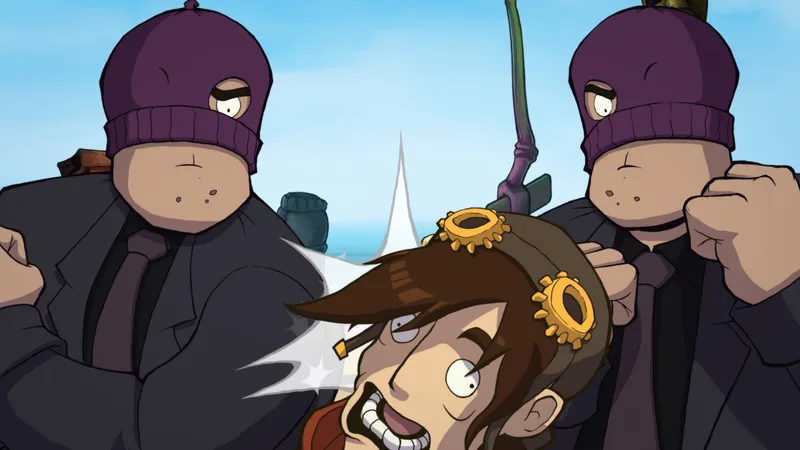
Organon — The army of clones that works for Elysium, led by Prime Controller Ulysses with Bailiff Argus as his second. They enforce Elysium's authority on the surface, and the series treats them as an occupying force with a hymn.
The Resistance — The organised opposition to the Organon on the surface. Rufus and Toni both end up attached to it, and it assigns its recruits numbers rather than using their names.
Prototype — What Hermes calls the three surviving clones he created: Rufus is Prototype R, Cletus is Prototype C and Argus is Prototype A. It explains why Rufus and Cletus are identical, which the first game presents as an unexplained coincidence.
Places you keep coming back to
Kuvaq — The surface village where the first game starts, south of Buusa-Westvoq. Rufus lives in Toni's house there and the whole opening section is about getting out of it.
Junk Mine — The mining works below Kuvaq, home to Doc's workshop, and the second flow section of the first game.
Floating Black Market — A trading post on the Rust Red Sea and the centre of Chaos on Deponia.
Porta Fisco — A larger surface town that features in Chaos on Deponia and Goodbye Deponia.
Hotel Menetekel — The hotel where Goodbye Deponia opens, and the setting for the towel and cultist-disguise sequence that most players remember from that game's first hour.
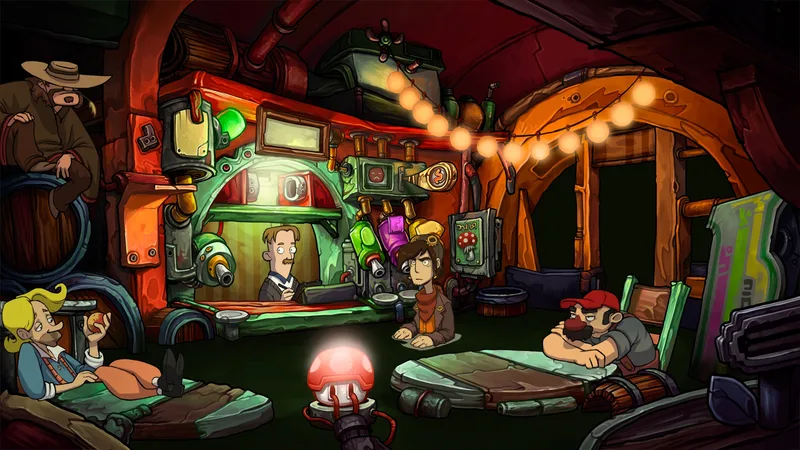
Lonzo's Bar — Kuvaq's drinking establishment, run by Lonzo. It is where the village's conversations happen, which in a point-and-click adventure means it is where several puzzle solutions are hiding.
Doc's Workshop — Doc's shop on the edge of the junk mines, where he sells spare parts and, when the plot requires it, performs brain surgery. The mine cart puzzle starts here.
Paradox City — A Doomsday location, and the clearest signal that the fourth game is playing by different rules than the trilogy.
Groups and titles
Council of Elders — Elysium's governing body. It is who Cletus answers to and, by extension, who the Organon ultimately serves.
Prime Controller — Ulysses' title at the head of the Organon. The rank exists to make clear that the occupation of the surface is administered, not improvised.
Bailiff — Argus' rank, second to Ulysses. In practice it means he is the one who actually turns up on Deponia to enforce things.
Prototype R / C / A — Hermes' names for his three surviving clones. Rufus is R, Cletus is C, Argus is A. The first game presents Rufus and Cletus looking identical as an unexplained coincidence; this is the explanation.
Number 2 / Number 26 — The Resistance identifies members by number rather than name. Rufus is Number 2 and Toni is Number 26, which tells you both how the organisation works and roughly how long each of them has been in it. The numbering is also a running joke about how seriously the Resistance takes its own security procedures.
Words the games make you learn
Platypus — The series' recurring animal joke, promoted to a plot device in Doomsday. The achievement Ornithorhynchologist — literally "someone who studies the platypus" — is one of the rarest in Goodbye Deponia at 7.0%.
Droggeljug — A nonsense word from the first game, and the name of its rarest achievement at 5.2% global unlock. Saying it back to the right character is the entire requirement, which is why almost nobody has it.
Elysium's fate — The question the whole series is pointed at, and the thing the announced spin-off Surviving Deponia says it will answer canonically. Nothing further about it has been published, so nothing further is claimed here.
Poki — The musician behind the series' songs. The Complete Journey adds six new tracks written and performed by them, which is one of the few concrete reasons to prefer the collection over the standalone releases.
Rust Red Sea — The body of water Bozo sails on a decommissioned garbage trawler, and where the Floating Black Market sits. It is the closest thing the surface has to open space.
Buusa-Westvoq — The settlement north of Kuvaq, mentioned to place Kuvaq on a map that the games otherwise never show you.